Robot Engineer: Unitree-Based Dog Assistant
Overview
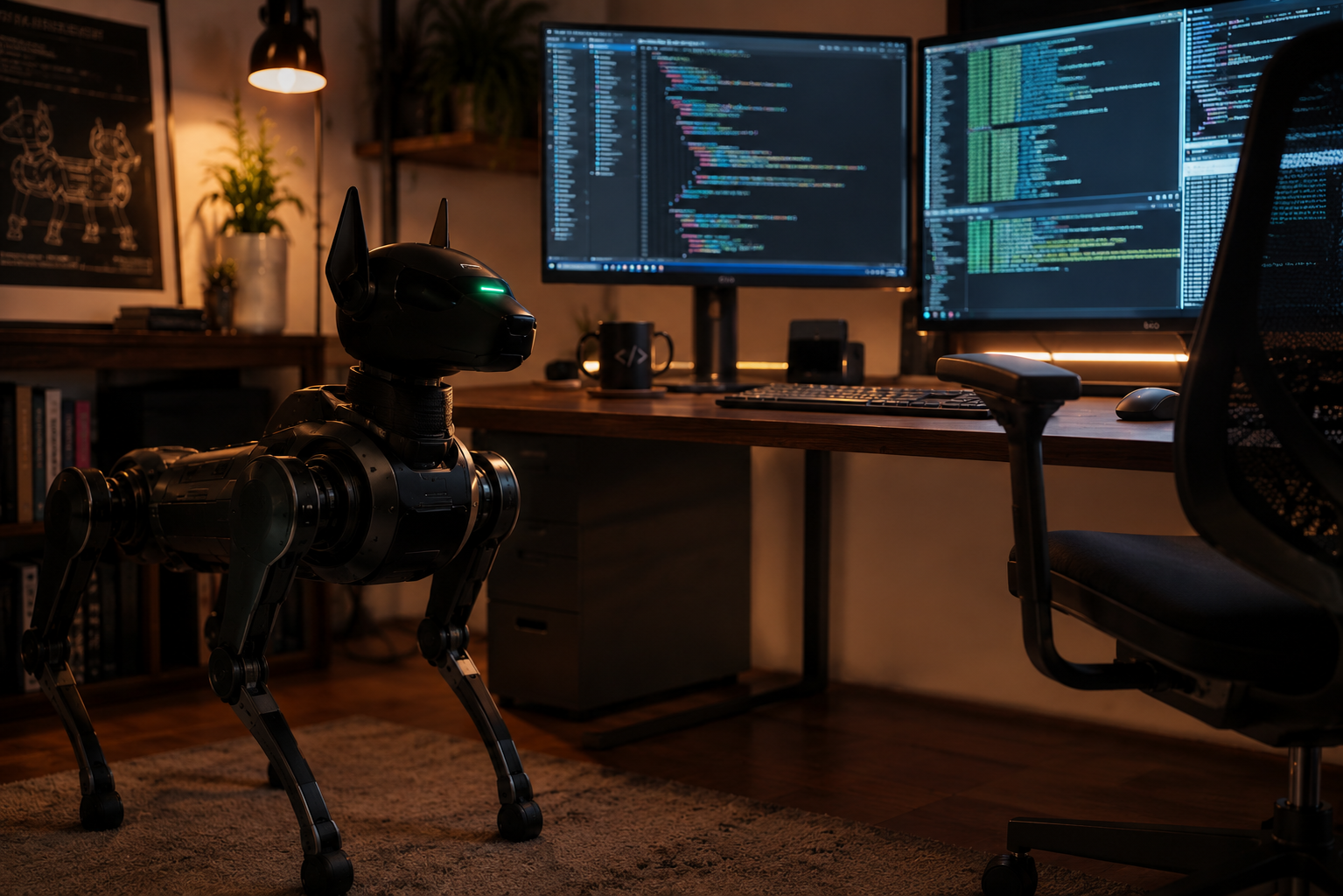
While a commercial 'robot engineer' does not exist yet, a DIY project based on Unitree Go2 is a real possibility: the platform handles the physical aspects, while an AI agent stack serves as the brain.
Is There a Ready-Made Solution?
No. Robotics manufacturers (Unitree, Boston Dynamics) focus on mechanics, navigation, and following, while AI agent developers focus on software. There is no product available yet where an autonomous robot dog is both a physical companion and a full-fledged engineer with deep context and code deployment capabilities.
However, the gap is not insurmountable: both halves already exist independently. The challenge is to connect them.
Two Layers: Body and Brain
The project breaks down into two independent parts:
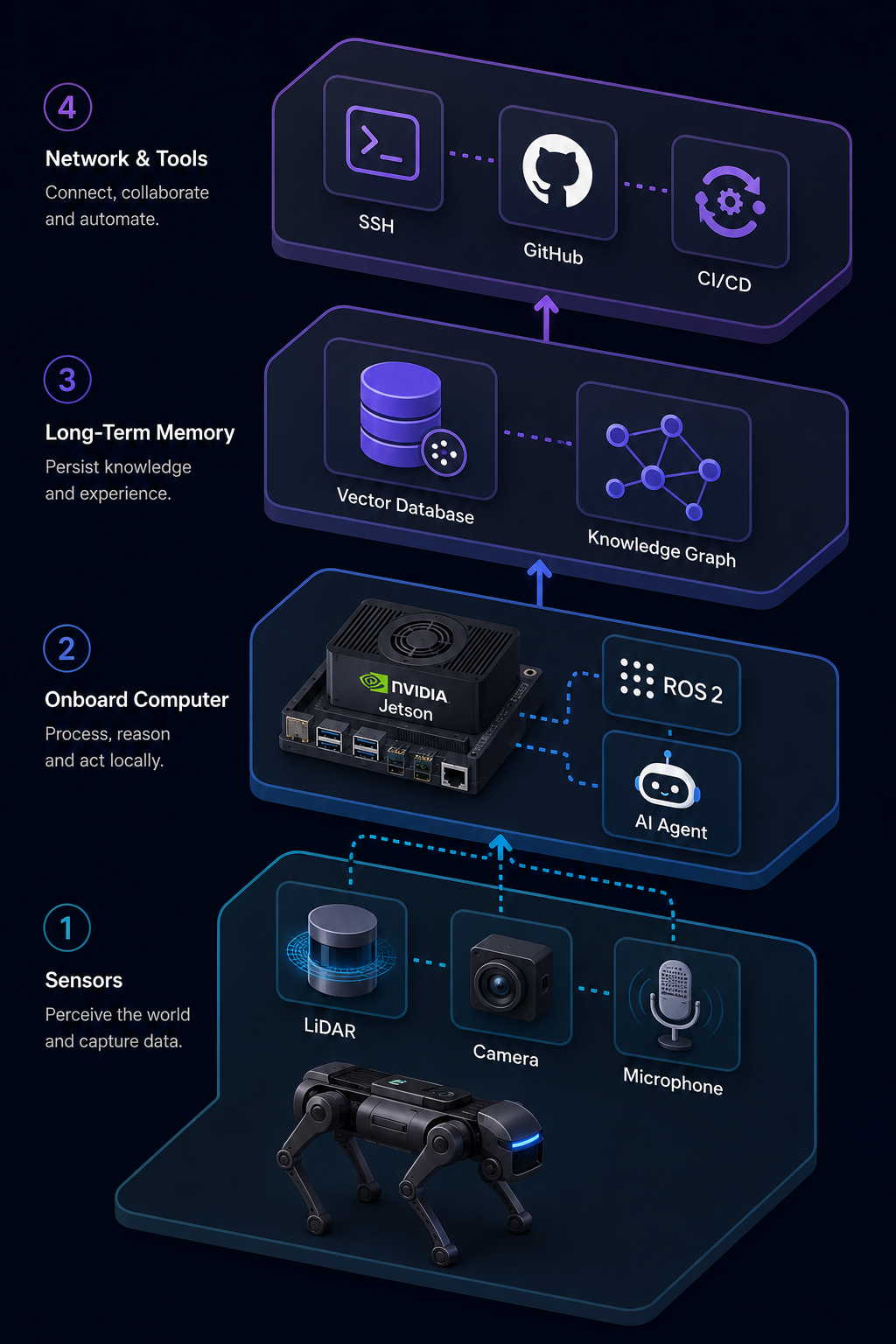
- Physical Body — robot dog Unitree Go2/B2: walking, balance, following, onboard computer, SDK.
- AI Brain — agent stack: LLM + tools + memory + connection to the developer's PC.
What Does the Hardware Do Out of the Box?
Following the Owner
The platform handles the physical aspects of the task: LiDAR, camera, and UWB tag allow the robot to confidently follow a person, navigate around obstacles, and maintain distance.
Onboard Computer
The EDU level versions are equipped with NVIDIA Jetson Orin — capable of running local neural networks directly onboard.
API and SDK
Unitree provides an open C++/Python SDK, ROS2 stack, and sensor access. This is the key to customization.
AI Brain: Agent Onboard
To make the dog more than just a companion, the onboard PC is connected to an agent framework:
- Orchestrator — LangChain, LlamaIndex, or a custom agentic loop;
- Tools — SSH, CLI, Docker, GitHub Actions through Function Calling;
- Memory — vector database + knowledge graph through MCP server.
The robot becomes a 'task server': you give a command via voice or chat — the agent connects via SSH, deploys, and checks logs.
Memory: Not an 'Infinite Window', but Three Layers
Trying to store the entire history in one context window is an anti-pattern: latency increases, costs rise, and quality drops (middle effect). The correct architecture is hybrid memory:
| Layer | What it Stores | Cleanup |
|---|---|---|
| Working Memory (context window) | Current task + system prompt + extracted facts | Reset between tasks |
| Episodic (short-term) | Logs of recent commands, process statuses | TTL + summarization |
| Semantic (long-term) | Facts about projects, servers, rules | Updated only with new knowledge |
Detailed breakdown with code — in the practical guide "Building a Robot Engineer on Unitree".