Robot Simulation
Briefly
Simulation is a virtual playground where a robot learns to walk, balance, and manipulate objects without breaking hardware or risking injury. Results are then transferred to a real robot.
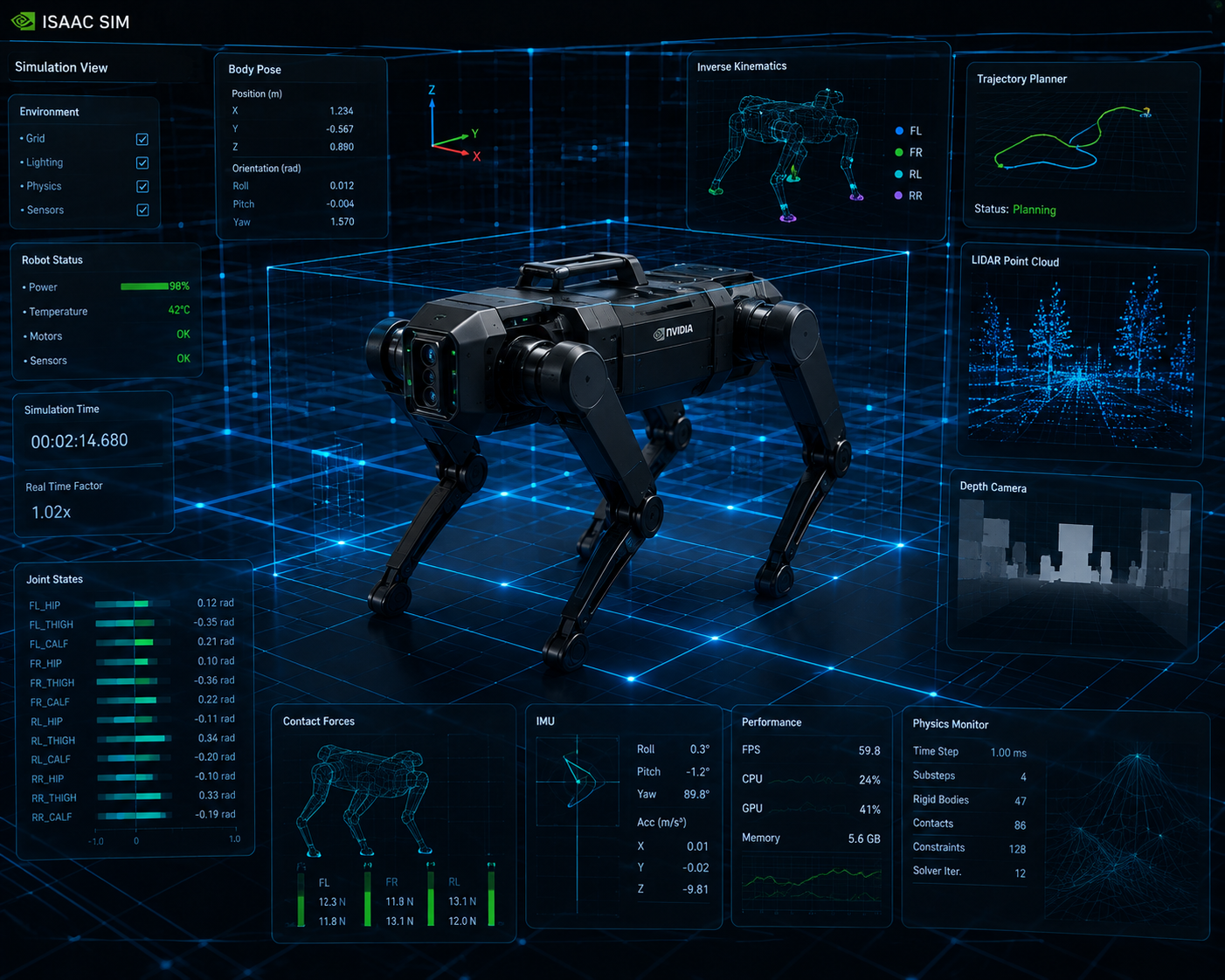
Why Simulation is Needed
Training a robot in the real world is expensive and dangerous. One wrong step can cause a costly robot to fall. In simulation, thousands of parallel scenarios can be run, time can be accelerated, and failures can be repeated as many times as needed.
Main Platforms
| Platform | Features | For What |
|---|---|---|
| Gazebo | Open, classical | Robots with ROS |
| Isaac Sim | From NVIDIA, based on PhysX | Industry, reinforcement learning |
| MuJoCo | Lightweight, precise physics | Research, RL |
| PyBullet | Simple, Python-based | Quick prototyping |
How Training Occurs in Simulation
A typical path involves reinforcement learning (RL):
- The robot receives a task, for example, "walk forward without falling".
- A reward for each successful step, a penalty for falling.
- The agent tries millions of times, gradually improving its strategy.
- The learned policy is transferred to a real robot.
Transfer Problem
The real world is more complex than simulation: friction, sensor noise, wear and tear. Therefore, a model trained in simulation is often fine-tuned on a real robot, known as sim-to-real.
To make transfer easier, random disturbances are added to the simulation — domain randomization. The robot learns to cope with various conditions and becomes more robust.
Connection to LLM
Modern robots combine LLM for planning and simulation for movement practice. LLM decides "what to do," while the RL policy decides "how to move".