Model Quality Assessment
Briefly
Quality assessment is a way to measure how well a model performs its task. Metrics depend on the task: for text, perplexity and BLEU; for classification, accuracy and F1.
Why Assess
Without metrics, it's impossible to know if things got better after fine-tuning or changing the prompt. Assessment turns "it seems better" into a specific number that can be compared.
Metrics by Task Type
| Task | Metrics | What They Show |
|---|---|---|
| Text Generation | Perplexity | How surprised the model is by the text |
| Translation, Summarization | BLEU, ROUGE | How similar to the reference |
| Classification | Accuracy, Precision, Recall, F1 | How accurate the answers are |
| Question Answering | Exact Match, F1 | How precisely the answer matches |
Perplexity
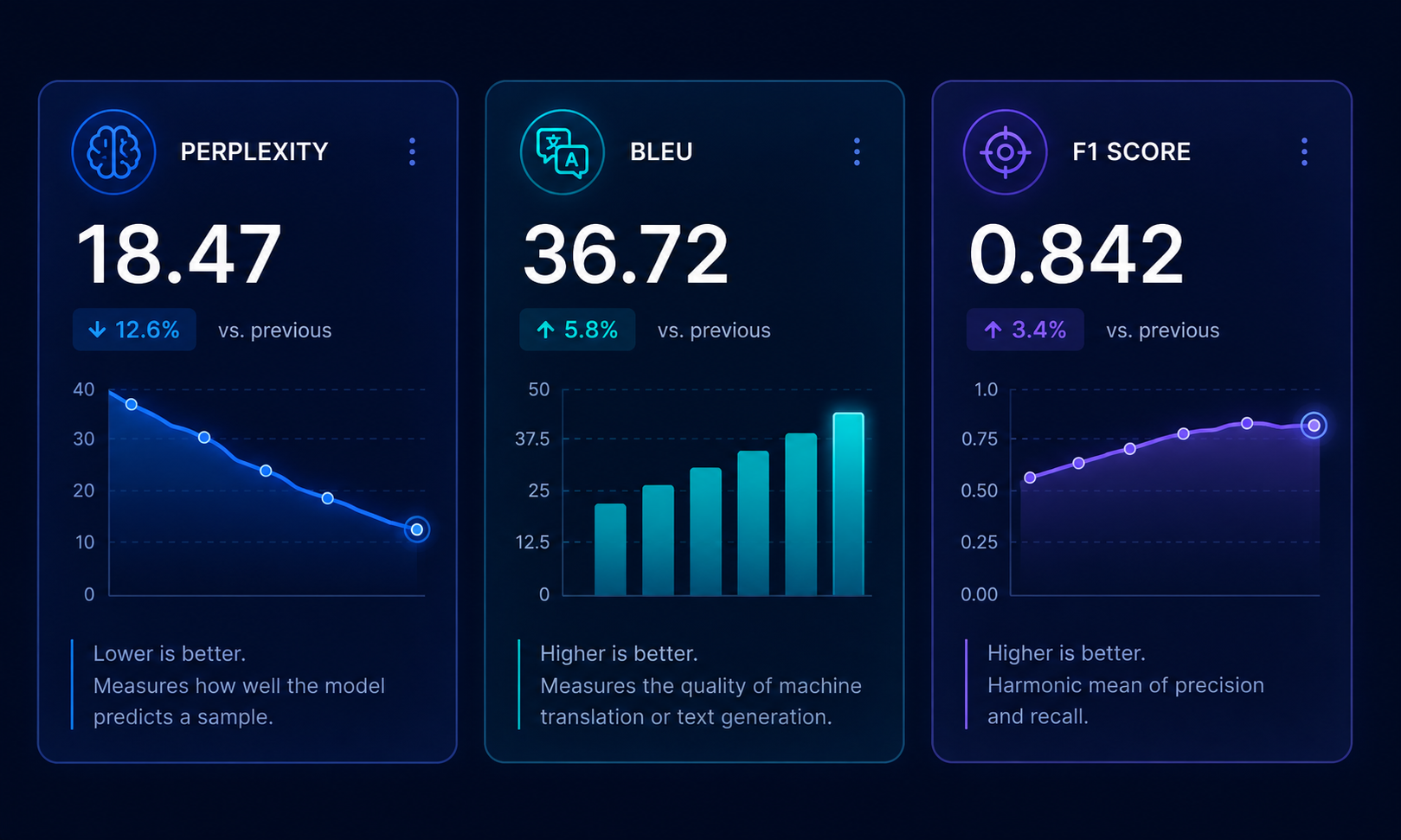
The main metric for language models. Calculated based on Cross-Entropy: the lower the perplexity, the better the model predicts the next token.
Low perplexity does not guarantee "smartness" in conversation—it only shows how confidently the model continues the text.
BLEU and ROUGE
- BLEU compares machine translation to a reference based on n-gram overlap. Used in translation.
- ROUGE is more often used for summarization—it looks at how well the machine summary covers key segments of the reference.
Both metrics are criticized for not considering meaning, only surface-level matches.
For Classification: Accuracy and F1
- Accuracy — the proportion of correct answers. Poorly works when classes are unevenly distributed.
- Precision — how many of the predicted "yes" were correct.
- Recall — how many of the actual "yes" the model found.
- F1 — the harmonic mean of Precision and Recall; balances them.
LLM-as-a-Judge
More and more, the quality of texts is assessed by another language model—a "judge." It reads the response and scores it based on given criteria. This is cheap and scalable, but requires careful prompting.