Neuromorphic Chips: Why They Are Needed and When to Expect Them
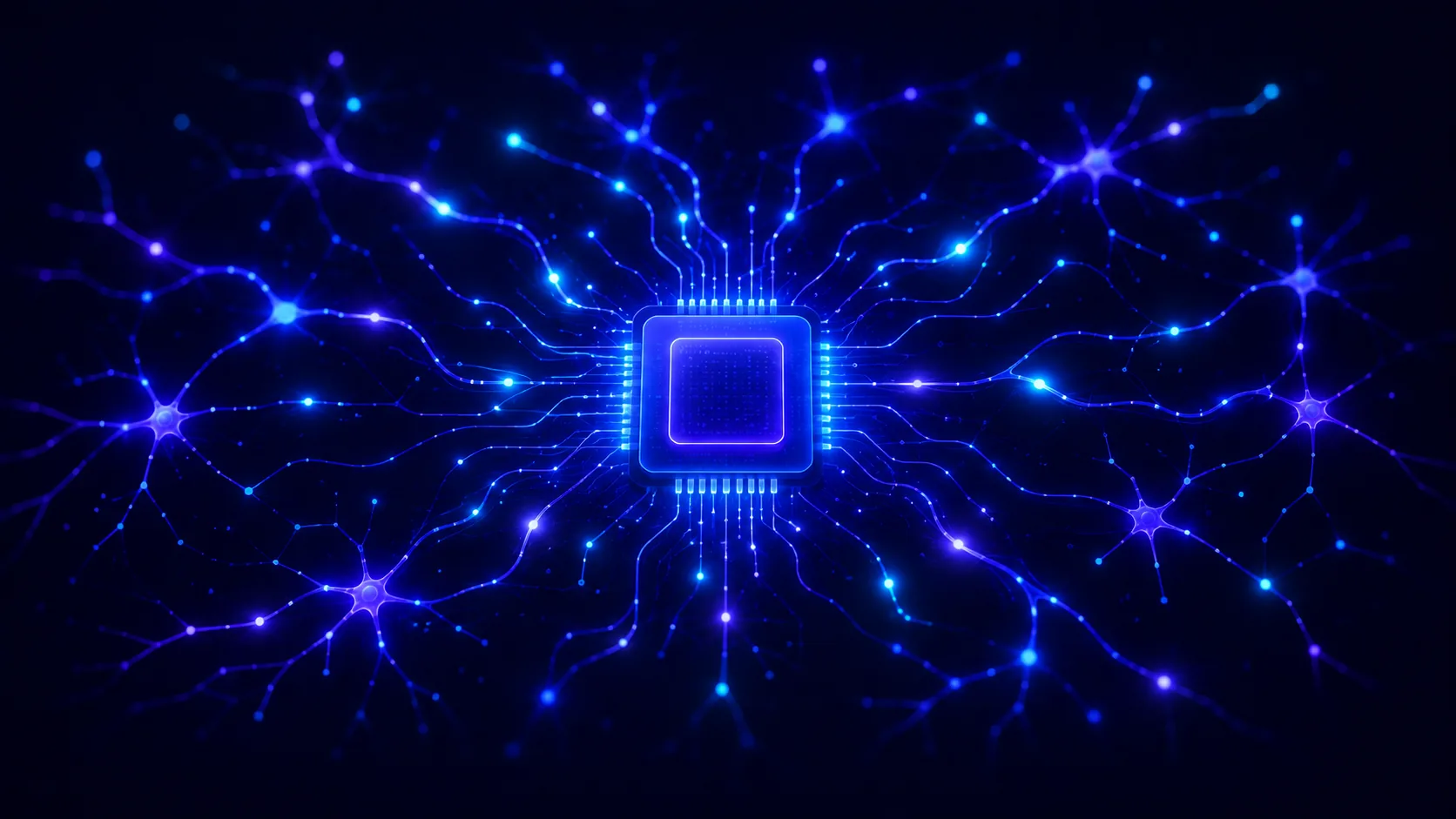
Regular processors compute numbers, neuromorphic ones mimic neuron behavior. We explore what makes this approach unique, its advantages, and why it's still far from mass market.
The Idea: Computing Like the Brain
A typical chip executes a sequence of commands: takes data, computes, and returns the result. The brain works differently: billions of neurons exchange impulses simultaneously, without a central clock generator.
Neuromorphic chips replicate this architecture on silicon: instead of bits '0/1', they use spikes (short impulses) that are transmitted between artificial neurons. Calculations happen where the state is stored—like in the brain, without data transfer between memory and processor.
flowchart LR
    A[Spiking event] --> B{Threshold exceeded?}
    B -->|Yes| C[Impulse generation]
    B -->|No| D[Silence<br>No energy consumption]
    C --> E[Impulse goes to neighbors]
    E --> A
What Sets It Apart from a Regular GPU
| Criterion | GPU | Neuromorphic Chip |
|---|---|---|
| Computation Model | Matrix operations | Spiking neural networks |
| Power Consumption | Hundreds of watts | Milliwatts |
| Parallelism | Massive, but synchronous | Event-driven, asynchronous |
| Time Processing | Separate | Built into the signal itself |
The key difference is event-driven: the chip only 'wakes up' when an impulse arrives. No data means no energy consumption. This is why neuromorphic systems are so efficient in real-time tasks.
Main Advantages
1. Energy Efficiency
The brain consumes around 20 watts, while a GPU for similar tasks consumes orders of magnitude more. Neuromorphic chips are approaching biological efficiency: thus, they are interesting for battery-powered devices.
2. Speed of Reaction
Spiking networks process signals as they come, without waiting for a 'full frame'. This is ideal for robotics: reaction to an obstacle—within fractions of a millisecond.
3. Low Latency in Streaming Tasks
Sensors, drones, hearing aids, sensors—anywhere continuous event stream processing is needed, the neuromorphic approach outperforms the classical one.
Why It's Still Not Mass Market
1. Different Programming Method
Typical neural networks are trained in PyTorch and then transferred. For neuromorphic chips, the model needs to be translated into a spiking form—this is separate engineering, tools are still raw.
2. Maturity of the Ecosystem
The GPU stack has been fine-tuned for decades: drivers, compilers, libraries. Neuromorphic chips don't have this yet—each project is largely custom.
3. Accuracy
Spiking networks on general-purpose tasks still lag behind typical ones. The advantage is noticeable in narrow scenarios, not everywhere.
What Exists Now
- Intel Loihi—an experimental neuromorphic processor;
- IBM TrueNorth—one of the first serial prototypes;
- SynSense and other startups—commercial chips for sensors and IoT.
These are niche products, but the direction is developing: interest is fueled by battery-powered devices and robots that need to 'think' quickly and efficiently.
When to Expect
Pragmatic forecast: in the coming years—growth in IoT, sensors, and robotics, where energy efficiency is critical. Full replacement of GPUs won't happen: rather, hybrid systems where the neuromorphic chip processes sensor data, and the GPU handles heavy models.