Curse of Dimensionality
The problem of high-dimensional spaces: the more features there are, the worse intuitive ideas about distance work.
What the Problem Is
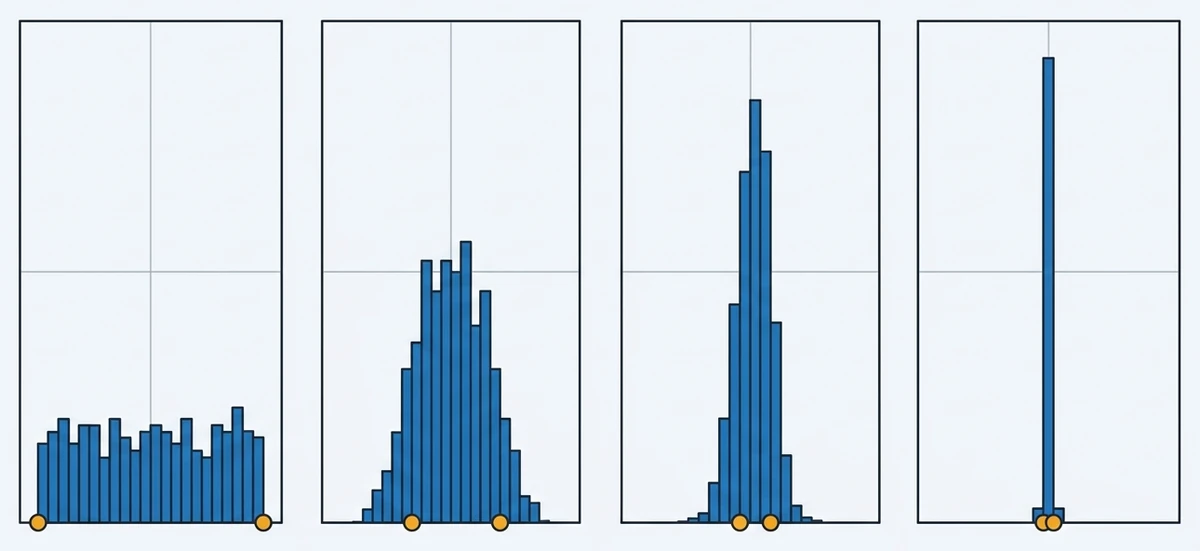
As dimensionality grows:
- the volume of the space grows exponentially, and the data in it becomes 'sparse';
- the distances between random points converge — the 'nearest' neighbor is hardly different from a 'far' one;
- maintaining the same density of points requires exponentially more data.
Who It Affects
First of all metric methods such as KNN and clustering: they rely on distances, and those lose their meaning.
What People Do
- reduce dimensionality (with PCA, for example);
- select features;
- use models that do not rely on distances.