Temperature and top-p: Controlling the Creativity of a Neural Network
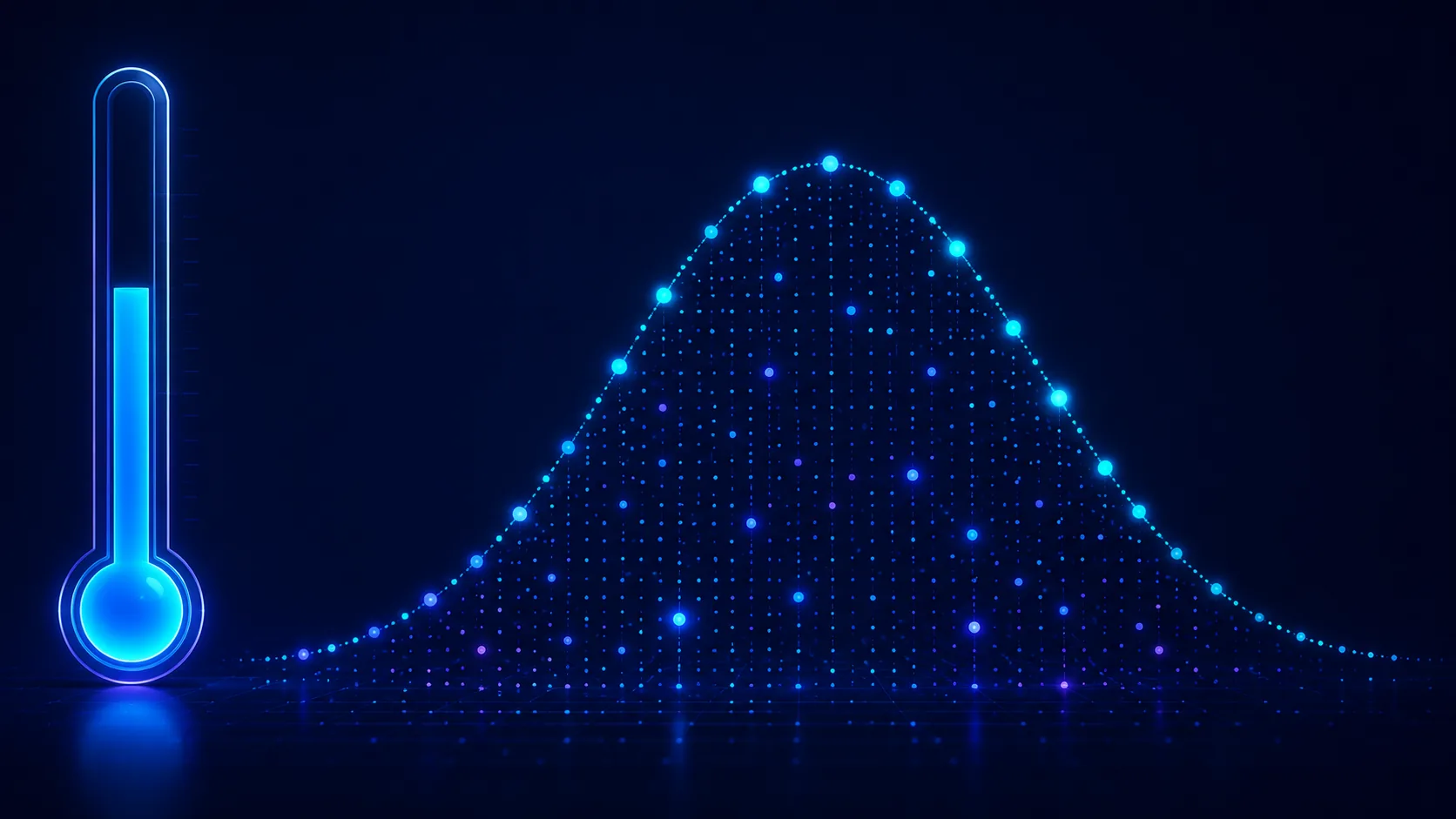
Why does the same model sometimes respond strictly to the point and other times spout unexpected ideas? It all comes down to two parameters: temperature and top-p.
What is Temperature
Temperature controls the 'boldness' of the model. At low temperatures, the model selects the most probable words — responses are strict and predictable. At high temperatures, it starts considering less probable options, making the text more varied but sometimes delving into nonsense.
| Temperature | Effect |
|---|---|
| 0.0–0.3 | Strict, predictable, to the point |
| 0.5–0.7 | Balanced |
| 0.8–1.2 | Creative, risky |
What is Top-p
Top-p (nucleus sampling) limits the selection: the model considers not all tokens but the minimal pool that sums up to probability p. With top_p = 0.9, the tail of the least probable words is discarded.
How They Work Together
Temperature sets the overall level of chaos, while top-p trims the tail of the distribution. They are often used in tandem:
- Facts and code: temperature 0.2, top-p 0.9.
- Creativity: temperature 0.8, top-p 0.95.
flowchart LR
    A[Token logits] --> B[Temperature<br>amplifies/smoothes variance]
    B --> C[Top-p<br>trims the tail]
    C --> D[Token selection]
Practical Recipes
- Summarization — temperature 0.2: important not to invent.
- Idea generation — 0.9: let it propose boldly.
- Dialogue — 0.7: naturally, but not chaotically.
- Code — 0.1: predictability is key.